
For the owner of a dog who suddenly seems old
When did she get old?
The plain-English guide to your dog’s golden years — and to the question behind every one of them: is this normal, or is this a vet visit?

Exactly what you get
The Core Guide48 pages · 15 chapters in four parts · organized by question, not by day
- Part 1 — what aging actually is: joints, senses, the engine room, and the aging brain, in plain English
- Part 2 — the sorting guide: normal or vet visit, signal by signal (the water bowl, the weight, the nights)
- Part 3 — the home: traction, routine, movement redesigned, food and grooming she can’t do alone
- Part 4 — the honest part, handled with immense care: preparation, never prediction
- Every claim attributed: AAHA senior-care guidelines, AVMA, WSAVA, veterinary-school resources
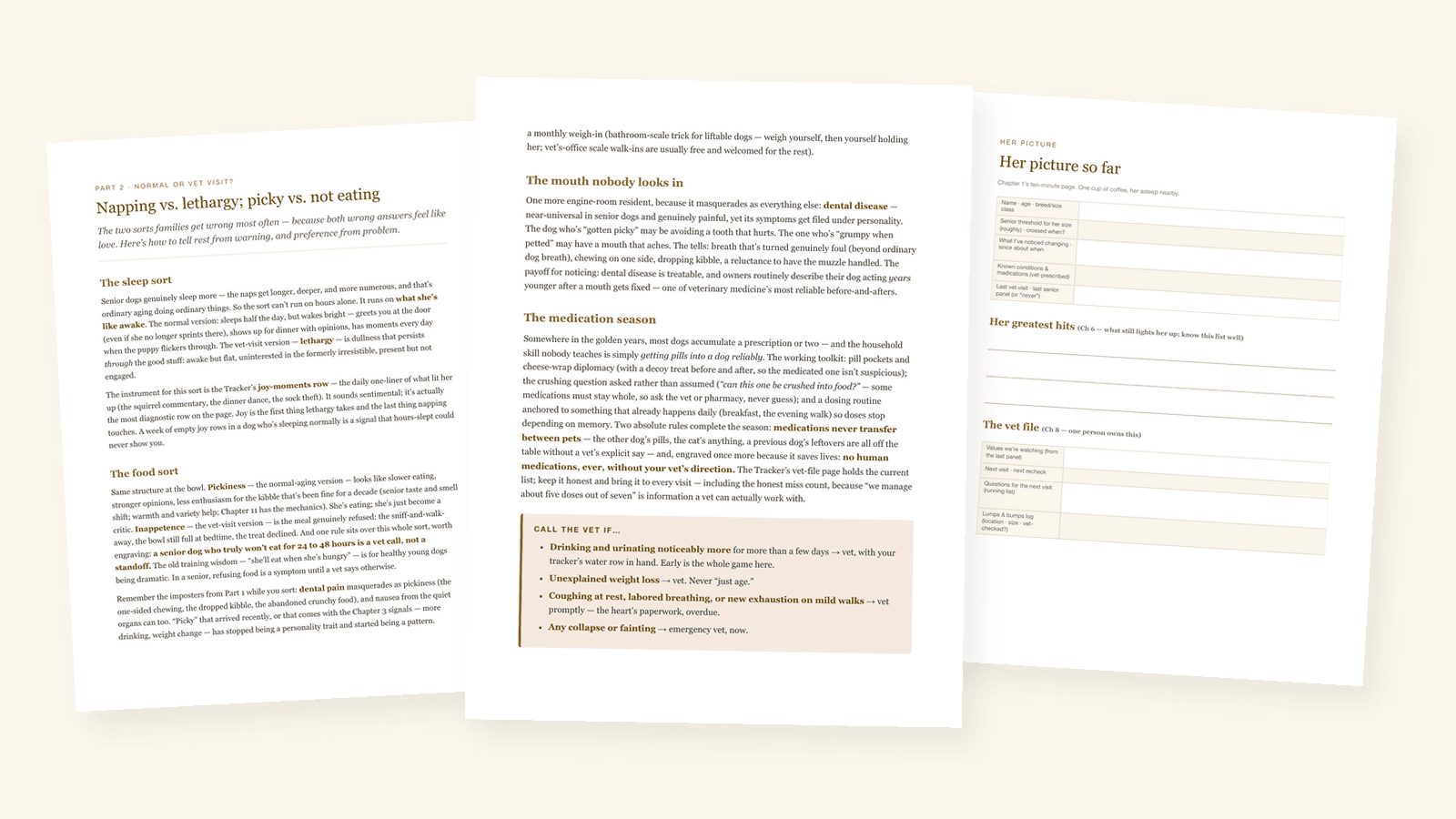
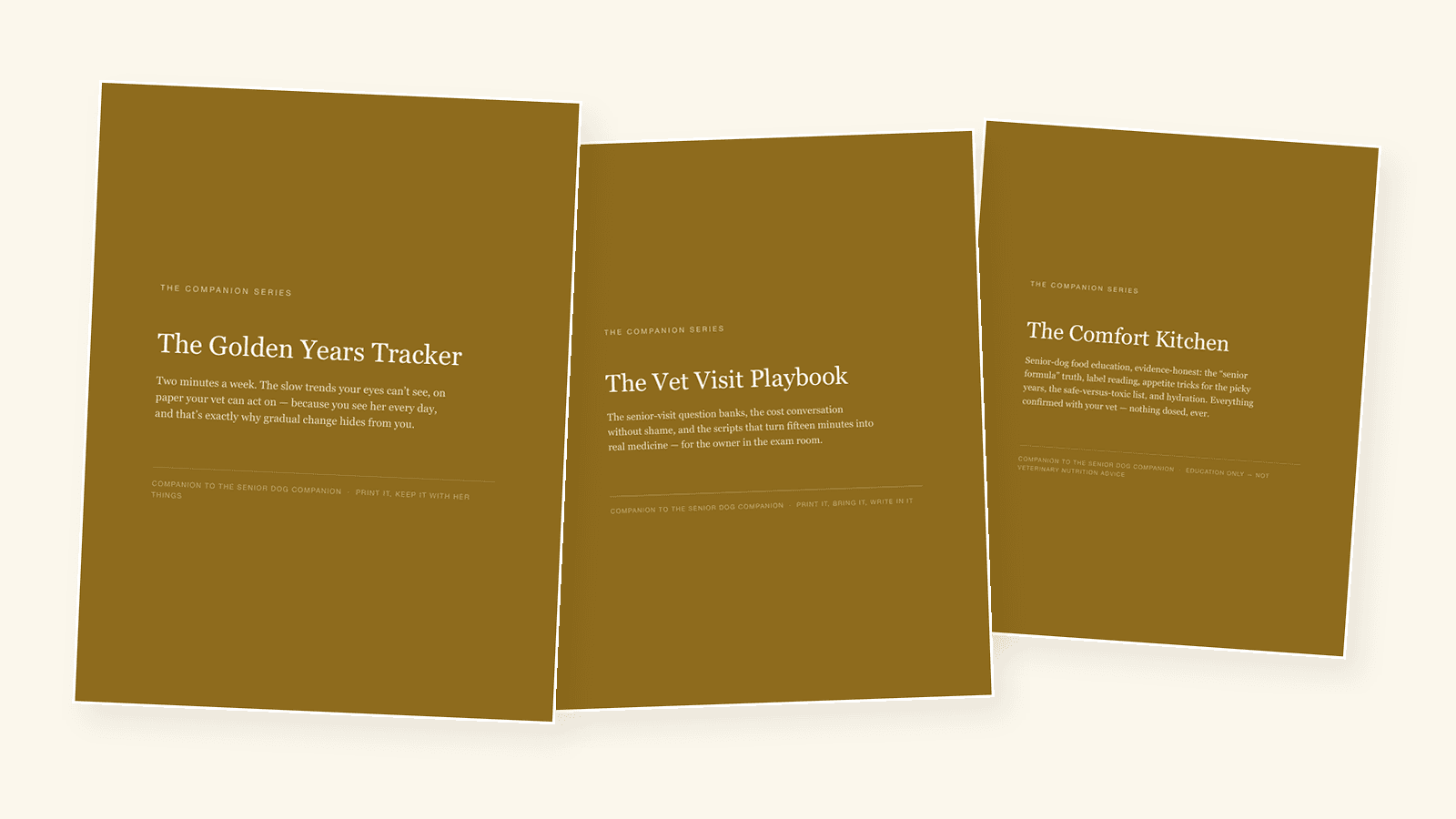
The Golden Years Tracker7 pages · two minutes a week · printable
- Her baseline page — what changed, and roughly when
- The weekly rows: mobility, appetite, water, sleep, joy-moments — the slow trends eyes miss
- The vet file and the emergency page, filled in before you need them
- The monthly quality-of-life check-in — trend lines a 15-minute visit never sees
The Vet Visit Playbook6 pages · scripts by situation
- The 15-minute-visit problem, solved with preparation: what to bring, what to ask first
- The senior-panel conversation, and the questions that make bloodwork useful
- The cost conversation, asked without shame — estimates, options, and staging
The Home Comfort Checklist4 pages · room-by-room · most fixes cost less than one vet visit
- Traction, ramps, raised bowls, lighting, and the ten-minute floor audit
- Checkbox format — walk the house once, fix the highest-impact items first
Four PDFs (five with “The Comfort Kitchen”) · instant download · yours forever · start the tracker tonight.
The internet's alternative is a 2 a.m. scroll between doom and dosing advice that hurts dogs. This is the calm version: what veterinary guidelines actually say, organized around the question you're really asking — is this normal, or is this a vet visit?
- The Core Guide — what aging actually is, and the sorting question the whole book answers: normal, or vet visit?
- The Golden Years Tracker — two minutes a week of organized noticing, built to catch the slow trends eyes miss
- The Vet Visit Playbook — how to bring a 15-minute appointment a case file instead of a vague worry
- The Home Comfort Checklist — the room-by-room printable that makes the house fit her body again
4 PDFs · 48-page core guide · 15 chapters organized by question · no doses, ever — every clinical call routes to your vet
30-day money-back guarantee — full refund, keep the tracker.
Secure checkout by Shopify · Published by The Reset Series · Files delivered to your email the moment payment clears
The moment it landed
Maybe it was the stairs — the pause at the bottom that was never there before. Maybe it was the grey climbing her muzzle in a photo from only two years ago. Maybe it was the afternoon she didn’t hear the car in the driveway, and kept sleeping, and you stood there watching her breathe.
And right behind the recognition came the guilt: how did I miss this? Here’s the answer, and it’s biology, not inattention: dogs are built to hide decline. Masking weakness is deep canine wiring. The shift snuck up on you because she’s designed to make sure it would — which is why the job of this chapter isn’t raising her anymore. It’s noticing. And noticing is a learnable skill.
You’re afraid of over-reacting and afraid of under-reacting. The answer to both fears is the same: a pattern log and a vet partnership.
Sound familiar?
- The hesitation at the stairs, the jump she quietly stopped attempting
- The water bowl you’re refilling more often — and can’t remember when that started
- The “ignoring you” that might be her ears
- The bluish haze in her eyes you keep meaning to ask about
- The restless nights, the pacing, the accident on the rug that shamed you both
- The 2 a.m. search spiral that made everything scarier, not clearer
Grounded in
AAHA Senior Care Guidelines · AVMA · WSAVA nutrition guidance · veterinary-school resources (Cornell, Tufts) · the Villalobos Quality of Life Scale
The map — 15 chapters, organized by your questions
Part 1 — What aging actually is
- When did she get old?
- Her body, part 1: joints, muscle, and the senses
- Her body, part 2: the engine room
- The senior brain
Part 2 — Normal, or vet visit?
- Slowing down vs. limping
- Napping vs. lethargy; picky vs. not eating
- The signals that are never just age
- The senior panel, explained
Part 3 — The home, made to fit her
- The house, at nose height
- Routine as medicine; movement that fits
- Food, water, and the grooming she can’t do alone
- The household around her
Part 4 — The honest part, with care
- Quality of life, measured with love
- What the road can look like
- Grief is love with nowhere to go
The covenant this book keeps
No doses. Ever. The internet is full of “give your dog X for pain” advice, and it is how dogs get hurt — common human pain relievers like ibuprofen can be dangerous for dogs, and the book says so plainly, once, as safety education. Every treatment question in the Companion ends at the same door: your vet, with hands on your dog. No supplement pushes either — the joint aisle gets the honest-evidence treatment, not a checkout link.
And your vet is not the villain of this story. They’re working 15-minute appointments with a patient who can’t talk. What changes the math is you arriving organized — the tracker’s trend line, the what-changed log, the written questions. Observation is your job; medicine is theirs. This book is the bridge between the two.
Who it’s for: your dog is somewhere around 7 to 14, the moments above landed a little too well, and you want the noticing skills and the calm — not a miracle cure or a countdown. Not for you if you want diagnosis-by-PDF or treatment instructions; the first doesn’t exist and the second belongs to your vet.
Everything in the bundle
The internet's alternative is a 2 a.m. scroll between doom and dosing advice that hurts dogs. This is the calm version: what veterinary guidelines actually say, organized around the question you're really asking — is this normal, or is this a vet visit?
- The Core Guide — what aging actually is, and the sorting question the whole book answers: normal, or vet visit?
- The Golden Years Tracker — two minutes a week of organized noticing, built to catch the slow trends eyes miss
- The Vet Visit Playbook — how to bring a 15-minute appointment a case file instead of a vague worry
- The Home Comfort Checklist — the room-by-room printable that makes the house fit her body again
4 PDFs · 48-page core guide · 15 chapters organized by question · no doses, ever — every clinical call routes to your vet
30-day money-back guarantee — full refund, keep the tracker.
Secure checkout by Shopify · Published by The Reset Series · Files delivered to your email the moment payment clears
Not ready to buy? Start free.
“Normal or Vet Visit?” — the five signs that deserve a vet conversation, plus one week of the Golden Years Tracker to start tonight. One PDF, sent to your email. No card, no strings.
Checkout collects only your email — $0.00, no card fields.
Questions, answered honestly
Is this a substitute for taking my dog to the vet?
No — and it says so on every surface. The Companion teaches you to notice, document, and prepare; your vet does the medicine. The whole design pushes toward the exam room: an owner holding a pattern log calls the vet with more confidence, not less.
Does it tell me what medications or doses to give?
Never. No doses, no drug recommendations, no supplement pushes — and it's plain about why: internet dosing advice is how dogs get hurt, and human medications like ibuprofen can be dangerous for dogs. Every treatment question in the book ends the same way: ask your vet.
My dog is only 7 — is this premature?
Likely not. AAHA defines 'senior' as roughly the last quarter of expected lifespan — around 10 for small breeds, 9 for medium, 7 for large, 6 for giant breeds. Many dogs are seniors for years while still acting three. Starting the noticing habit early is the whole advantage.
Does it cover the end-of-life part? I'm not sure I can read that.
Yes — as its own part, written with immense care, and designed to be read early, while she's napping in a sunbeam. It's preparation, not prediction: the quality-of-life tools vets actually use (introduced with attribution), what the options are, and how to make sure nothing ambushes you. No countdown language, ever.
What exactly do I get, and how?
Four PDFs — the 48-page Core Guide, the Golden Years Tracker, the Vet Visit Playbook, and the Home Comfort Checklist — delivered instantly after checkout. Read on any device; the tracker and checklist print or fill in any PDF app. No login, no app, no subscription.
Refunds?
Thirty days, full refund, no hoops.